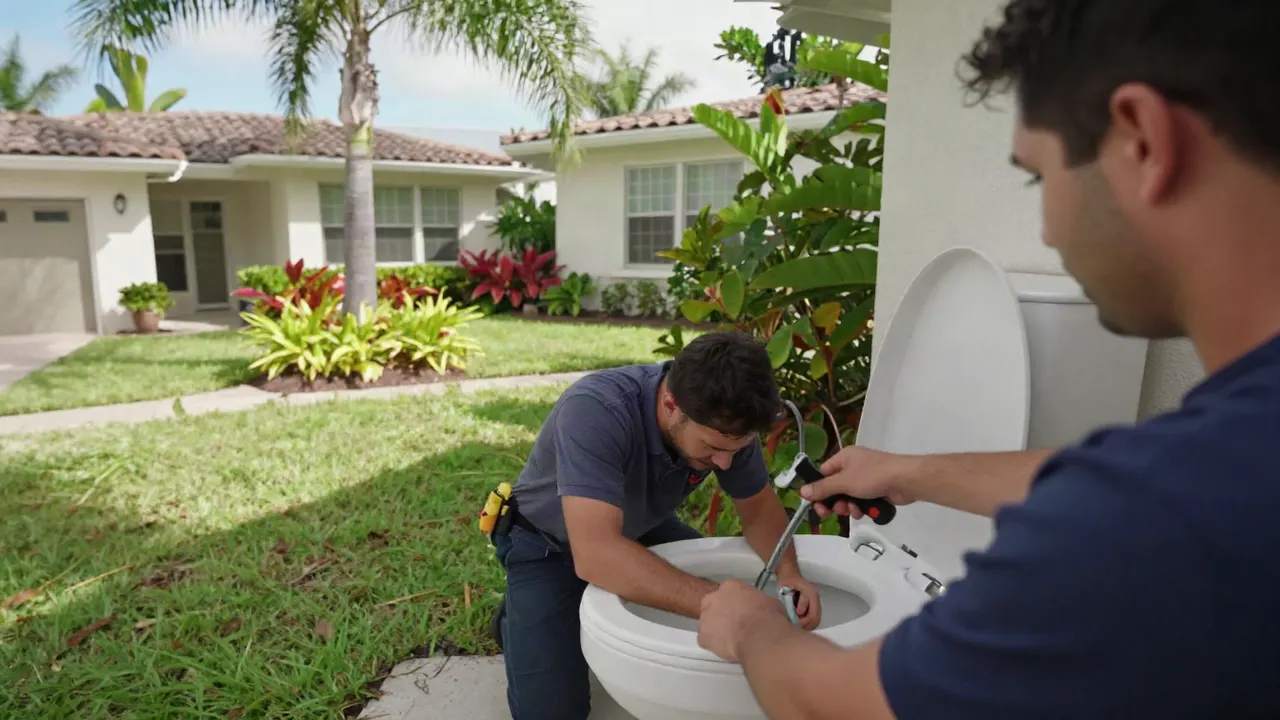
A toilet that runs constantly is almost always caused by a worn flapper, a faulty fill valve, or a stuck float - three parts that cost under $25 combined and take about 20 minutes to replace. If you hear water trickling long after the tank should have refilled, you're wasting 200 gallons a day or more, and that shows up on your next Vero Beach utility bill. The fix is usually simple, but knowing which part failed saves you from replacing the wrong thing. Below, we walk through the diagnosis, the repair, and the point where you should stop and call us.
Why your toilet keeps running
A toilet running constantly Vero Beach FL homeowners deal with is a plumbing problem where the tank never fully shuts off the water supply, so the fill valve keeps cycling every few minutes. The cause is mechanical, not mysterious. Water is escaping the tank when it shouldn't, and the fill valve is doing its job by replacing it - over and over.
Here are the four parts that fail, in order of how often we see them:
- Flapper - the rubber seal at the bottom of the tank. It warps, cracks, or gets a mineral film on it. Water leaks past it into the bowl, the tank level drops, and the fill valve kicks on. This is the culprit in roughly 7 out of 10 running toilets we service.
- Fill valve - the tall plastic assembly that refills the tank. The diaphragm inside wears out, or the float mechanism sticks. Sometimes the valve runs but never shuts off completely.
- Float - the ball or cup that tells the fill valve when to stop. If it's set too high, water spills into the overflow tube continuously. If it's waterlogged, it sinks and the valve never gets the signal to close.
- Flush valve seat - the opening the flapper seals against. If it's pitted or scaled, even a brand-new flapper won't seal. This is more common in older Vero Beach homes with hard water.
One more possibility: the refill tube - the small hose clipped to the overflow tube - can slip down into the water. If it's siphoning, the tank drains itself slowly. It takes five seconds to check and reposition.
How to diagnose a running toilet in 10 minutes
You don't need special tools to figure out which part is failing. You need a flashlight, a few minutes of quiet, and this sequence.
Step 1: Listen and watch
Take the tank lid off - set it somewhere it won't slide, because they crack easily. Flush the toilet and watch what happens. If the water level rises above the overflow tube and keeps spilling, your float is set too high or the fill valve isn't shutting off. If the water settles and then you hear a faint hiss or trickle 30 seconds later, the flapper is leaking.
Step 2: The dye test
Put a few drops of food coloring in the tank. Don't flush. Wait 15 minutes. If color appears in the bowl, the flapper or flush valve seat is leaking. That's your problem. If the bowl stays clear but you still hear water, the fill valve is the issue.
Step 3: Check the flapper by hand
Turn off the water supply at the wall valve, flush to empty the tank, and feel the flapper. It should be soft, pliable, and flat. If it's stiff, curled at the edges, or covered in a chalky film, replace it. Run your finger around the flush valve seat - if it feels rough or gritty, that's mineral buildup, and you'll need to clean or replace the seat too.
Step 4: Check the float height
With the water back on and the tank refilling, watch where the water stops. It should sit about 1 inch below the top of the overflow tube. If it's at or above the tube, adjust the float down - usually a screw or a clip on the fill valve arm.
How to stop a running toilet yourself
If the dye test pointed to the flapper, this is a 15-minute job. Turn off the water at the wall, flush to drain the tank, unhook the old flapper from the overflow tube, and take it to the hardware store to match. Flappers are not universal - bring the old one. Install the new one, hook the chain with about 1/2 inch of slack, turn the water back on, and flush three times to test.
If the fill valve is the problem, the job is slightly bigger but still DIY-friendly. Shut off the water, drain the tank, disconnect the supply line, unscrew the lock nut under the tank, and pull the old valve out. New fill valves run $10-$20 and come with instructions. Set the height so the critical level mark sits 1 inch above the overflow tube. Reconnect, turn the water on, and adjust the float until the tank stops at the right level.
While you're in there, check the supply line and shutoff valve. In Vero Beach homes built before 1990, we often find corroded angle stops that won't fully close - if yours is stuck or weeping, that's a sign to have a residential plumber Vero Beach FL look at the whole fixture before you button it back up.
If the toilet is older than 1994 - the year the 1.6-gallon standard took effect - and you're replacing parts for the second time in a year, replacement usually makes more sense than another repair. A new toilet uses 1.28 gallons per flush versus the 3.5 to 7 gallons older models use. Our team handles toilet repair and installation Vero Beach FL and can tell you in one visit whether repair or replacement is the better call.
How much does it cost to fix a running toilet in Vero Beach FL?
Typical 2026 pricing in this area runs $125 to $275 for a professional running toilet repair, including the part and the service call. A flapper replacement alone is on the low end; a fill valve replacement or a flush valve seat repair pushes toward the higher end. If the toilet needs to be pulled and the wax ring replaced, expect $250 to $400.
DIY parts cost is $8 to $25 for a flapper, $10 to $20 for a fill valve, and $5 to $12 for a flush valve seal kit. The savings are real, but so is the risk of getting the wrong part or overtightening a plastic nut and cracking the tank - a mistake that turns a $15 fix into a $200 toilet replacement.
For comparison, a running toilet wastes roughly 200 gallons a day at a steady trickle, or up to 6,000 gallons a month if the flapper is badly warped. At Vero Beach water rates, that's real money every month you wait. Most repairs pay for themselves within two billing cycles.
Common mistakes that make it worse
We see these every week when we get called to a toilet that a homeowner already tried to fix.
- Buying a universal flapper. They fit some tanks and not others. A flapper that doesn't seat properly will leak worse than the old one. Bring the old flapper to the store.
- Overtightening the fill valve lock nut. Hand-tight plus a quarter turn is enough. More than that cracks the tank or the valve body.
- Bending the float arm to adjust the level. On modern fill valves, the float is adjusted with a screw or by sliding the float cup. Bending the arm on a plastic valve breaks it.
- Ignoring the overflow tube height. If the fill valve is set so the water level is above the overflow tube, the toilet will run forever no matter how many flappers you install.
- Not replacing the supply line while you're in there. A $6 braided line is cheap insurance against a burst line under the tank.
One more: if you have hard water - and most Vero Beach homes do - mineral scale builds up on the flush valve seat. A new flapper won't seal against a scaled seat. You have to clean it with a descaling product or replace the flush valve assembly.
When to call a professional
Call us if the toilet runs after you've replaced the flapper and fill valve, if the tank is cracked, if the shutoff valve won't close, or if water is pooling around the base of the toilet. Those point to problems beyond a parts swap - a failed flush valve seat, a broken tank bolt, a failing supply line, or a wax ring that's given out.
We also get calls from homeowners in Downtown Vero Beach and the older neighborhoods along the river where original 1960s and 1970s plumbing is still in service. Those toilets often need more than a flapper - the fill valve, supply line, and shutoff all fail around the same time. We replace all three in one visit so you're not calling us back in six months.
If you're not sure whether it's a DIY job or a service call, call us and describe what you're hearing. We'll tell you straight. If it's a $15 flapper, we'll say so. If it's a fill valve that needs replacing, we can be there the same day in most of Vero Beach.
And if you're already dealing with water damage from a toilet that's been leaking - soft flooring, stained ceiling below, musty smell - that's a bigger issue than the toilet itself. Our leak detection and repair Vero Beach FL team can trace where the water has gone and stop it before it spreads.
Frequently Asked Questions
Why is my toilet running constantly in Vero Beach FL?
The most common cause is a worn flapper that no longer seals against the flush valve seat, letting tank water leak into the bowl. The fill valve then cycles every few minutes to replace it. Hard water in Vero Beach accelerates flapper wear, so this is a frequent call for us.
How do I stop my toilet from running in Vero Beach Florida?
Start with the dye test: add food coloring to the tank, wait 15 minutes, and check the bowl. If color appears, replace the flapper - a $10 part and a 15-minute job. If the bowl stays clear, the fill valve is the issue and needs replacement or adjustment.
How much does it cost to fix a running toilet in Vero Beach FL?
Professional repair runs $125 to $275 in 2026, including parts and the service call. A simple flapper replacement is on the low end; a fill valve or flush valve seat repair is higher. DIY parts cost $8 to $25.
Can I fix a running toilet myself in Vero Beach FL?
Yes, if the flapper or fill valve is the problem. Both are straightforward replacements with basic tools. If the tank is cracked, the shutoff valve won't close, or the toilet runs after you've replaced both parts, call a plumber.
How much water does a running toilet waste?
A steady trickle wastes about 200 gallons a day - roughly 6,000 gallons a month. That's enough to move your water bill noticeably and enough to cause long-term damage to the flapper and valve seat if left alone.
Get help with Plumber in Vero Beach
If your toilet is still running after a flapper swap, or you'd rather not spend your Saturday under a tank lid, we can be there today. We carry flappers, fill valves, and supply lines on every truck, so most running toilet repairs are done in one visit.
Call +1 (888) 721-1338 and we'll get your toilet quiet again.